Port Orford is the kind of place where people either immediately know it is right for them, or they know it is not. Some visitors step out of the car at Battle Rock Beach, look up at the headland, listen to the Pacific moving around the base of that sea stack, and go very quiet. They are already decided. Others, after an hour in town, begin calculating how long the drive back to Portland will take — and make a different decision. Both responses are honest. Port Orford is not for everyone. But for the right person, it may be the most extraordinary place to live on the Oregon Coast.
This post gives you the complete picture — the rewards and the real trade-offs — so that you can make an honest assessment of whether Port Orford belongs in your life. No overselling. The isolation is real. The service limitations are real. And the Pacific Ocean view from a headland home in the westernmost city in the contiguous United States, on a Tuesday afternoon with no one else around, is also real. You need to know about all of it.
Daily Life in a Town of 1,200
Port Orford has the basic infrastructure of small-town life: a small grocery store, a hardware store, a pharmacy, a post office, Battle Rock Coffee for your morning cup, and Redfish Restaurant for when you want to eat something genuinely excellent. The town functions. You will not need to drive to Gold Beach or Bandon every time you need something ordinary. But "functional" is the appropriate word, not "abundant." This is not a place where you can wander into a dozen different shops on a Saturday afternoon or choose between four restaurants for dinner. The footprint of commercial life in Port Orford is small.
What fills that space is the outdoors and the community. The outdoors is immediate and extraordinary — Battle Rock is visible from the main street, the trailhead for Port Orford Heads is a short walk away, Cape Blanco is five miles north, Humbug Mountain five miles south. You walk out your door and you are essentially inside the landscape. The community is small and coherent — a town of 1,200 where you know your neighbors, where the conversation at Battle Rock Coffee is substantive, where the Jubilee in July is something people look forward to all year. Community and landscape substitute for commercial variety in ways that, for the right person, feel like an upgrade rather than a compromise.
The Isolation: An Honest Account
Port Orford is genuinely remote by Oregon standards. Coos Bay, the nearest city of any size, is approximately 50 miles north. Medford, the nearest inland city with comprehensive services, is approximately 75 miles east over the Siskiyou Mountains — a drive that is scenic and, in winter, occasionally requiring tire chains. Portland is four and a half to five hours away under normal conditions.
What this means practically: you plan your errands. You stock your pantry. You know which things require a trip to Gold Beach and which require a trip to Bandon, and you combine those trips efficiently. You develop a different relationship with distance than you have if you live in a city or a larger town. This is not a hardship — people lived this way in coastal Oregon for generations, and many Port Orford residents find that the planning required by remoteness produces a more intentional, less reactive daily life. But it is a real adjustment, and it is worth sitting with honestly before you make a purchase decision.
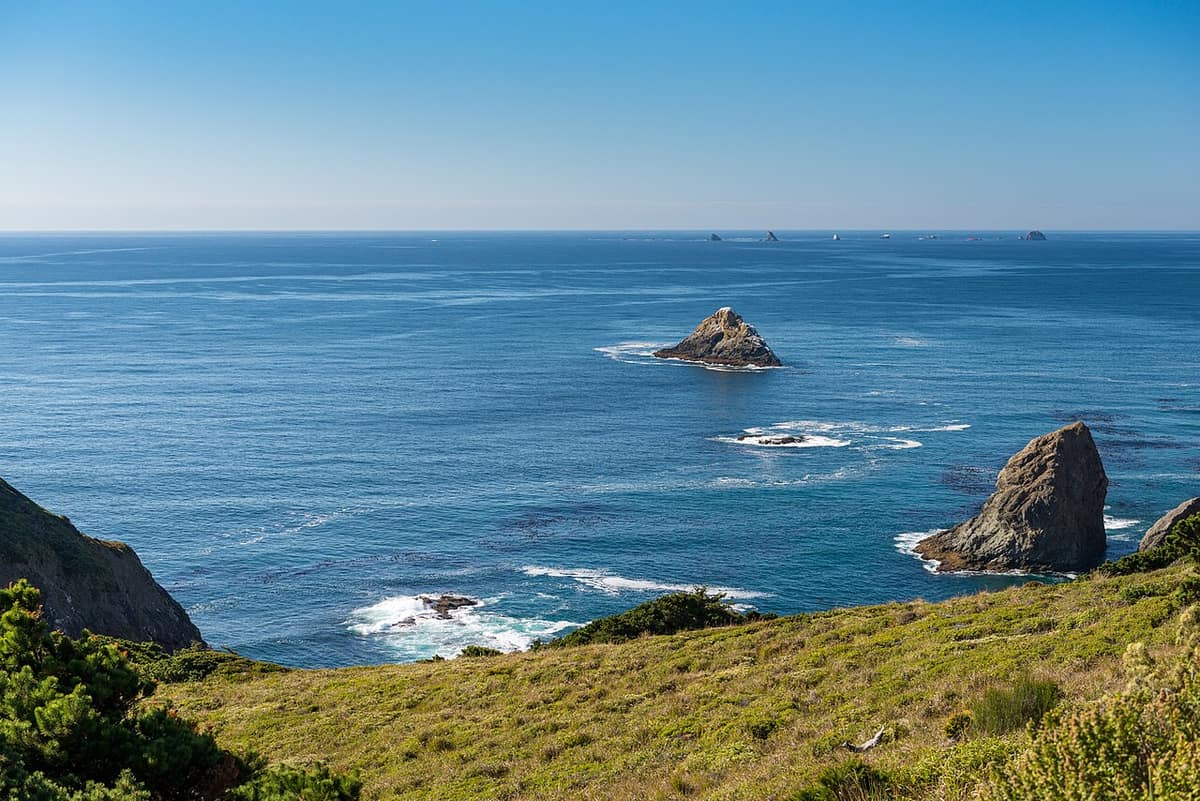
The Pacific from Port Orford Heads State Park — isolation has its compensations — Photo: Gary Halvorson, Oregon State Archives / Wikimedia Commons (CC BY 4.0)
Weather: Curry County's Banana Belt
Port Orford benefits from what residents of the southern Oregon Coast call the "banana belt" effect — a climatic moderation produced by the geography of the southern coast and the Siskiyou Mountains that results in noticeably milder winters and less summer fog than most of the Oregon Coast. If you have spent time in Cannon Beach or Astoria or Pacific City and found the persistent summer fog discouraging, Port Orford is a different experience. The summers here are sunnier and drier than most people expect from an Oregon coastal town. The winters are mild — significantly warmer on average than northern coast towns — with storms that can be dramatic but without the persistent gray that defines winter at the northern end of the coast.
Storm watching season (November through February) brings its own rewards for those inclined toward the dramatic. Port Orford's exposed headland position means ocean storms arrive with full force, and watching a Pacific storm from the cliffs above Battle Rock is one of those experiences that reminds you where you are in the world. The southern coast's storm season is gentler in temperature than the north, which makes the watching more comfortable even as the storms themselves can be impressive.
The Arts Community
Hawthorne Gallery in Port Orford has developed a national reputation for representing Pacific Northwest artists of genuine standing — not regional curiosities, but working artists whose work sells to collectors and institutions across the country. The gallery holds openings throughout the year that draw visitors from outside the region and that anchor Port Orford's identity as a place serious about art in a way that most towns its size are not.
The gallery is not the only thing. A surprising concentration of working artists — painters, sculptors, photographers, writers — choose to live in Port Orford year-round for the same reasons serious artists have always been drawn to remote places: the light, the quiet, the absence of the social machinery of larger cities, and the proximity to a landscape that is worth paying attention to. This community is present in town. You will encounter it at Battle Rock Coffee, at Hawthorne Gallery events, at the Jubilee. It adds a layer of cultural richness to Port Orford that is unusual for a town of this size and this remoteness.
The Fishing Community
Port Orford's fishing community is not decorative. The crane dock is a real working operation — one of the very few in the world that lifts its entire fleet out of the water after every trip, because there is no harbor, only a protected headland. The fishermen who operate from Port Orford are working in sea conditions that require skill and experience, and the fishing economy they support — particularly the sea urchin and Dungeness crab fisheries — is a real part of the town's livelihood.
This working character is part of what makes Port Orford feel different from coastal towns that have transitioned entirely to tourism and vacation-home economies. There are people here who fish for a living, who have fished these waters for generations, and whose presence gives the town a grounded authenticity that is hard to replicate and easy to value once you experience it.
Healthcare: The Most Important Practical Consideration
This deserves a direct answer because it is the single most important practical consideration for anyone thinking about full-time residency in Port Orford. The nearest hospital is Curry General Hospital in Gold Beach, approximately 28 miles south. If your medical needs are routine, this is a manageable distance. You plan your appointments, you know the drive, you understand what the response time looks like for emergency services.
Regular specialist care and advanced emergency services mean a longer drive to a larger hospital system. If quick access to that level of care matters to you, factor the distance honestly into the decision now rather than discovering it after you have moved.
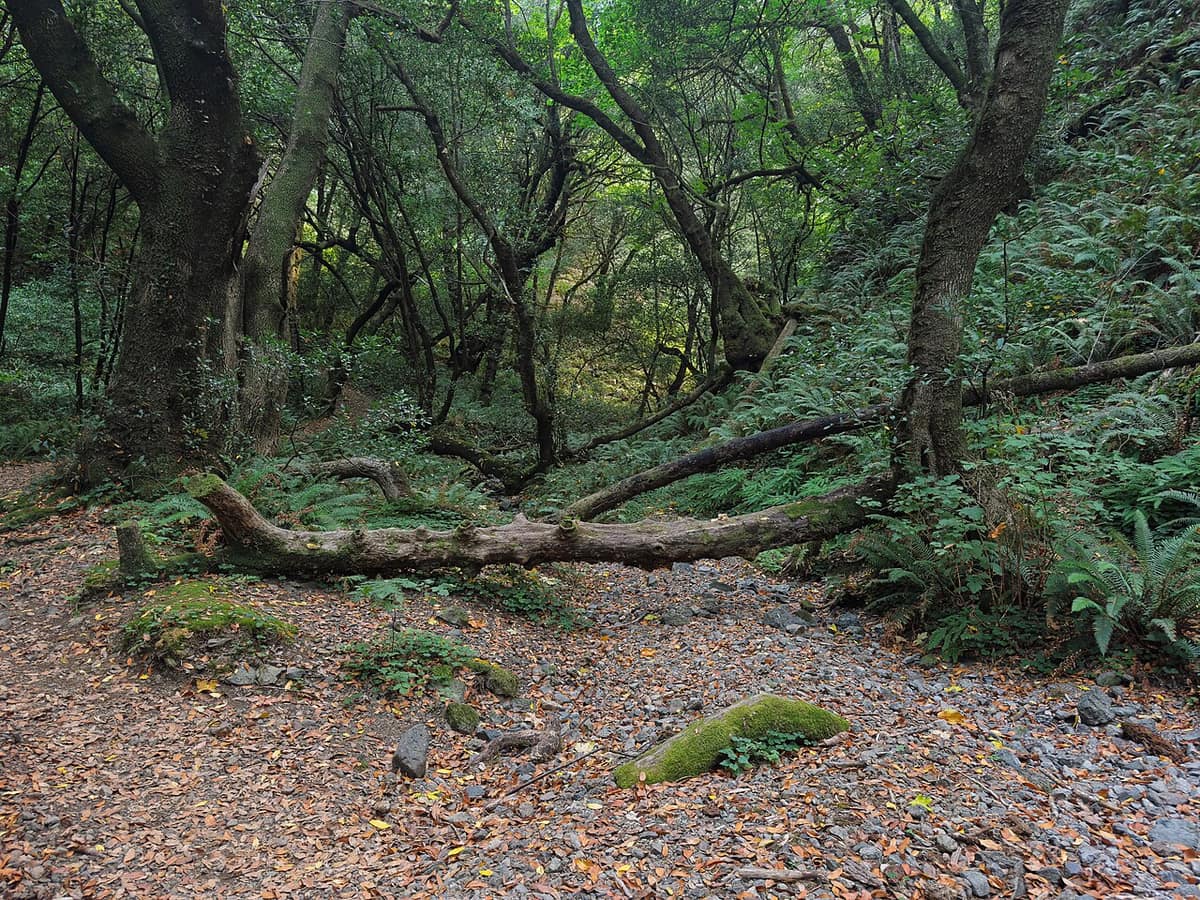
Bay laurel forest at Humbug Mountain State Park, just south of Port Orford — forests, beaches, and sea stacks with no crowds — Photo: Z3lvs / Wikimedia Commons (CC0)
Internet and Remote Work
Satellite internet options have made remote work increasingly viable in rural Oregon over the last several years, and Port Orford has benefited from this. Many residents work remotely full-time without significant difficulty. That said, connectivity quality and reliability vary by property and provider, and you should verify the specific options available at any address you are considering before making a purchase decision. "Satellite internet is available in the area" is not the same as "this property has reliable, high-speed connectivity adequate for video calls and large file transfers." Do your homework here, particularly if remote work is the financial foundation of your Port Orford life.
Who Port Orford Is Right For
Among people who have considered this town seriously — those who moved here and those who decided against it — a few clear profiles emerge for whom Port Orford works well:
- Artists, writers, and creative professionals who prioritize an extraordinary working environment and a community of serious peers over proximity to cultural infrastructure
- Remote workers with reliable internet who have done the homework on connectivity and whose work does not require frequent in-person attendance
- Outdoor recreationalists for whom Cape Blanco, Humbug Mountain, Battle Rock, and uncrowded Pacific beaches constitute primary daily satisfaction
- Anyone who genuinely wants to be away from everything — not as a romantic notion but as a considered, researched preference for quiet, beauty, and community over services and convenience
- Fishermen and those connected to the marine economy of the southern Oregon Coast
And a few trade-offs that make Port Orford difficult for some buyers:
- Comprehensive medical care is a drive away, not around the corner
- Dining and shopping options are limited, which can feel diminishing rather than simply different
- There is no city or significant population center nearby for social or professional life
- Isolation is easy to romanticize and harder to sustain — test it before you buy
The Takeaway: Port Orford is the town that fits a very specific kind of life — one organized around landscape, community, authenticity, and the willingness to give up ease in exchange for something harder to name. The people who are right for Port Orford tend to know it within an hour of being there. If something in this post is pulling at you, that is worth following. Talk financing with Phuong →
Thinking about buying in Port Orford? Coastal homes come with their own financing questions — second home or rental, flood insurance, condo eligibility. Phuong Ha, a licensed Oregon loan officer (NMLS #1839449), can help you sort them out before you make an offer.