Every real estate market has its talking points — walkability, school ratings, proximity to amenities. Brookings, Oregon has something that no other town on the Oregon Coast can claim: a documented, measurable, geographically explained climate advantage that makes it the warmest and sunniest place on the coast. The nickname "Oregon's Banana Belt" is not a chamber of commerce invention. It is a climatological description of a real phenomenon, and it is the single most important fact a buyer needs to understand before comparing Brookings to any other Oregon Coast town.
This post explains what the banana belt actually is, why it exists, what the numbers say, and what it means in practical terms for people who want to live here.
The Geography: Why Brookings Is Different
To understand the banana belt, you have to understand what causes typical Oregon Coast weather in the first place. The Oregon Coast is subject to persistent marine influence — cool, moist air masses that flow in from the Pacific, often producing low clouds, fog, and rain. This pattern is consistent and year-round, with the fog layer being particularly prominent in spring and early summer. It is why Lincoln City averages fewer sunny days than inland Portland, why Cannon Beach is famous for dramatic gray skies, and why many people who visit the northern Oregon Coast in June wonder where summer went.
Brookings sits at the point where the Klamath Mountains come closest to the Pacific Coast — the mountains, part of the broader Klamath-Siskiyou range, create a topographic barrier that fundamentally alters the coastal weather dynamics for this stretch of southern Oregon. Where the marine layer typically rolls inland unchecked at northern coast locations, it encounters resistance at Brookings. Fog that would blanket Lincoln City is blocked or deflected. Cold air masses that dominate coast weather further north are moderated. The result is a microclimate that reads closer to coastal northern California than to the central or northern Oregon Coast.
The Numbers: What the Climate Data Shows
| Climate Metric | Brookings | Comparison |
|---|---|---|
| USDA Hardiness Zone | 9a | Same as much of coastal California |
| Average January High | ~55°F | Cannon Beach ~48°F; Portland ~47°F |
| Sunny Days / Year | ~76 | Portland ~52; many N. Coast locations lower |
| Summer High Range | Upper 60s–70s | Moderated by Pacific; not inland-hot |
| Marine Fog | Less than N. Coast | Still present, particularly June/July mornings |
| Winter Freeze Events | Rare | Zone 9a rarely drops below 20°F |
The January high temperature of around 55°F is the number that most surprises visitors from northern Oregon. On a January day when Portland is in the low 40s under heavy overcast, Brookings can be in the low 60s with sun. This happens not rarely but regularly. The Klamath Mountain barrier means that the cold, wet atmospheric patterns that dominate Pacific Northwest winters are moderated here in a way they simply are not further north.
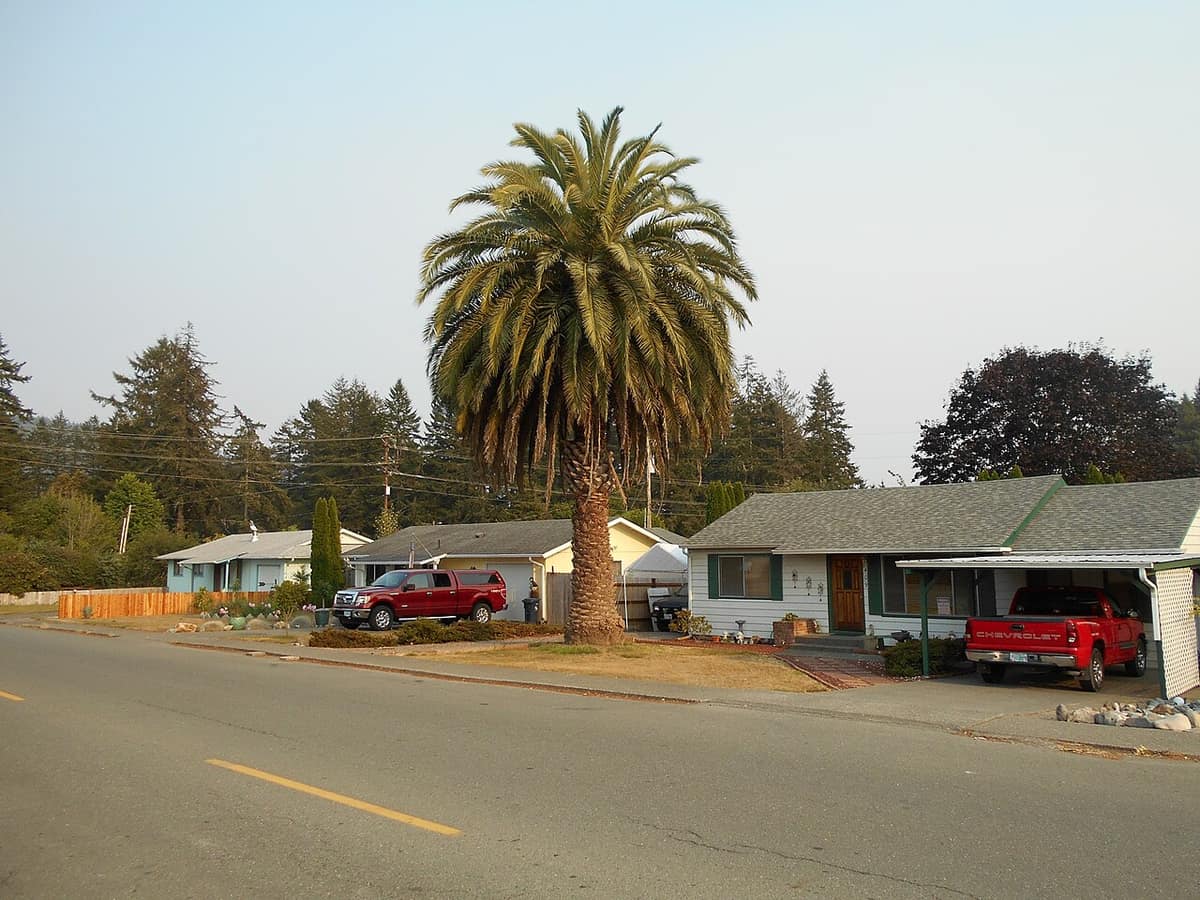
A mature palm tree in a Brookings neighborhood — the USDA Zone 9a climate supports year-round gardening — Photo: Robert Ashworth from Bellingham, WA., USA / Wikimedia Commons (CC BY 2.0)
What This Means Day to Day
Year-Round Gardening
USDA hardiness zone 9a is the key classification for understanding what actually grows in Brookings. Zone 9a means minimum winter temperatures rarely drop below 20–25°F, and in coastal Brookings with its marine moderation, hard freezes are unusual events rather than seasonal expectations. Camellias, which struggle everywhere north of Sacramento in typical Oregon conditions, bloom through winter in Brookings. Lilies, citrus (with protection), and a wide range of temperate-climate plants that would fail in most of Oregon thrive here. Year-round vegetable gardening is genuinely possible in a way that it is not at northern Oregon Coast locations.
Outdoor Living Extends Through the Year
One of the most practical implications of the banana belt climate is the extension of comfortable outdoor living beyond the summer months. At Chetco Brewing Company's dog-friendly patio, people are outside in January when the weather cooperates — and in Brookings, it cooperates with unusual frequency for an Oregon winter. Lunch on the patio at Catalyst Seafood, a morning walk on Harris Beach, a late-afternoon visit to Azalea Park — these are not activities limited to July and August. They are regular winter and spring activities for Brookings residents in a way that would be aspirational for residents of Lincoln City or Astoria.
The Azalea Festival Connection
The reason Brookings' most famous event falls on Memorial Day weekend is directly connected to the banana belt climate. The native Western azaleas bloom in late May, which in the banana belt is often warm and clear when the rest of the Oregon Coast is still in fog and cool temperatures. Memorial Day weekend in Brookings, held in this favorable weather window, delivers festival conditions that would be significantly more challenging further north. The climate is not incidental to Brookings' community character — it has shaped the town's traditions and rhythms in ways that are deeply embedded.
The Fog Reality: Managing Expectations Honestly
Honesty about the banana belt requires acknowledging that it is not a fog-free paradise. The Pacific Ocean still produces marine layer, and Brookings still experiences it. June and July mornings in particular can bring low clouds and overcast conditions that burn off mid-morning but are present at dawn. The pattern is less persistent and less thick than at northern coast locations, and the clearing tends to happen earlier, but it would be misleading to describe Brookings as entirely fog-free. The accurate description is: significantly less fog than northern Oregon Coast locations, with fog events that tend to be shorter in duration and less dense, particularly outside the June–July marine layer season.
The Temperature Ceiling: Why Brookings Isn't Inland-Hot
The other common misunderstanding about the banana belt is the assumption that warmer and sunnier means hot summers. Brookings' summers are genuinely pleasant rather than hot — the Pacific Ocean moderates the temperature ceiling in ways that prevent the 90s and 100s that define summer in the Rogue Valley and Willamette Valley interior. Typical summer high temperatures in Brookings range from the upper 60s to the mid-70s, occasionally touching 80°F but rarely sustaining those temperatures. This is the same Pacific moderation that makes coastal California's summers so livable, and it applies in Brookings. You get more sunshine and warmth than anywhere else on the Oregon Coast without the punishing heat of inland Oregon summers.
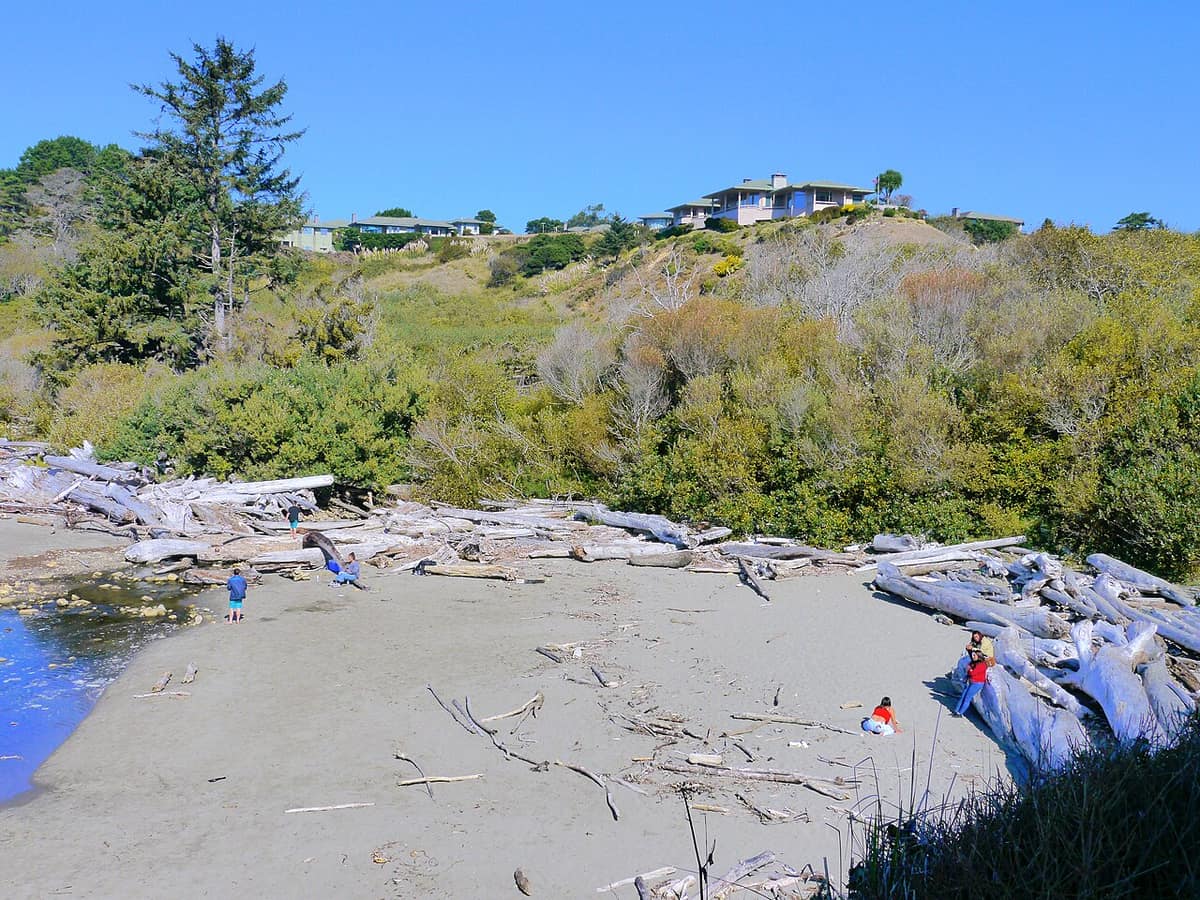
Clear skies at Harris Beach State Park — the Klamath Mountains shield Brookings from much of the coast's characteristic fog — Photo: Rick Obst / Wikimedia Commons (CC BY 4.0)
What the Banana Belt Means for Buyers
The climate premium is structural, not incidental. Brookings buyers pay for that climate, and residential properties here can cost more than comparable non-oceanfront properties in some northern Oregon Coast towns — with the climate as the primary reason. This is not speculation about why prices are higher; it is the documented, documented-by-migration experience of buyers who have specifically moved to Brookings for the weather.
Day to day, the banana belt climate has specific implications for quality of life: less cold and damp, year-round outdoor activity, lower heating bills, and the kind of consistent mild weather that makes outdoor living not a seasonal treat but a year-round reality. The climate extends usable outdoor space and livable seasons in ways that translate directly into how the town feels on an ordinary Tuesday in November.
The Takeaway on the Banana Belt: If you're on the fence between Brookings and a less expensive southern Oregon Coast option, visit both locations in January. Not in July, when the entire coast is reasonably pleasant. January. The difference in what the banana belt means on a random January day — light, temperature, the ability to go outside without a heavy coat — is the difference that many buyers find decisive. If outdoor living matters to you in all twelve months, Brookings is in a different category from the rest of the coast.
Thinking about buying in Brookings? Coastal homes come with their own financing questions — second home or rental, flood insurance, condo eligibility. Phuong Ha, a licensed Oregon loan officer (NMLS #1839449), can help you sort them out before you make an offer.
Related reading