Almost every landmark on the Oregon Coast has a story about geology. Haystack Rock has a better one than most. The 235-foot basalt sea stack was formed by ancient lava flows — part of the Columbia River Basalt Group, which spread across the Pacific Northwest over millions of years and reached the coast in several massive flood basalt events. What stands on the beach at Cannon Beach today is the remnant core of one of those flows, left standing after the surrounding rock eroded away over thousands of years of wave action. The Pacific Ocean has been working on Haystack Rock for a very long time, and it is still standing.
For the people who own property in Cannon Beach — and for those considering it — Haystack Rock is not just a backdrop. It is the defining feature of the address. Understanding what the rock is, what it protects, and what it means to live within sight of it gives a clearer picture of what the Cannon Beach real estate premium is actually purchasing.
The Rock Itself: Scale and Ecology
At 235 feet, Haystack Rock is the third-largest intertidal monolith in the world. That ranking puts it in context: this is not a large sea stack by the standard of any Oregon beach. It is a geological feature of global significance, in the same category as formations that draw scientists and naturalists from around the world. It sits approximately 100 yards offshore, accessible on foot at low tide across a wide, firm beach — which means it is not a distant view object but an experiential part of daily life for anyone who walks the Cannon Beach shoreline.
The tidepools surrounding the rock are designated a Marine Garden — a specific Oregon designation that provides protection beyond standard coastal regulations. The pools support a dense and diverse intertidal community: ochre sea stars, giant green anemones, hermit crabs, sculpin, chitons, and dozens of other species that rely on the tidal zone for their habitat. The Marine Garden designation means the area is actively monitored and protected, which in turn means the ecological richness that draws visitors and residents to the rock will be there for the foreseeable future.
The Puffins
Tufted puffins nest in burrows on Haystack Rock from approximately May through August each year. This is a fact that surprises almost everyone who hasn't spent time in Cannon Beach — puffins, with their distinctive orange bills and white face patches, are typically associated with Iceland or the coast of Maine in the American imagination. But the Pacific tufted puffin is a western species, and Haystack Rock's protected status as part of the Oregon Islands National Wildlife Refuge makes it one of the most accessible active puffin nesting sites on the continental Pacific Coast.
For residents, puffin season becomes a reliable annual pleasure. You learn to look for the birds at dusk when they return to their burrows, flying in fast and low over the surf. You develop a sense of the calendar — when the first birds arrive in spring, when the chicks are being fed, when the adults and juveniles head back to sea in late summer. Owning in Cannon Beach and having that seasonal rhythm as part of your life is one of the specific, unusual pleasures that doesn't appear on any listing sheet.
Also nesting on and around the rock: black oystercatchers, pigeon guillemots, pelagic cormorants, and Brandt's cormorants. Harbor seals haul out on nearby rocks. The wildlife viewing from the beach at Cannon Beach, with no additional equipment or preparation, is legitimately exceptional by any standard.
The HRAP Program
The Haystack Rock Awareness Program — HRAP — is a volunteer naturalist organization that stations trained guides at the rock during low tides from May through September. The guides are there to explain the ecology, answer questions, protect the tidepools from inadvertent damage by visitors, and generally serve as the human interface between the public and one of Oregon's most sensitive coastal ecosystems. The program is free, and the quality of the interpretation is genuinely high — HRAP volunteers know their subject in depth and communicate it accessibly.
HRAP is one of the most valuable educational amenities in Cannon Beach's civic life. Regular visits to the rock during low tide, guided by naturalists who can explain what you're seeing in the pools and overhead on the rock, build a kind of environmental literacy that most places never offer. And HRAP makes the beach experience richer every time you encounter a guide working with a group at the rock's base.
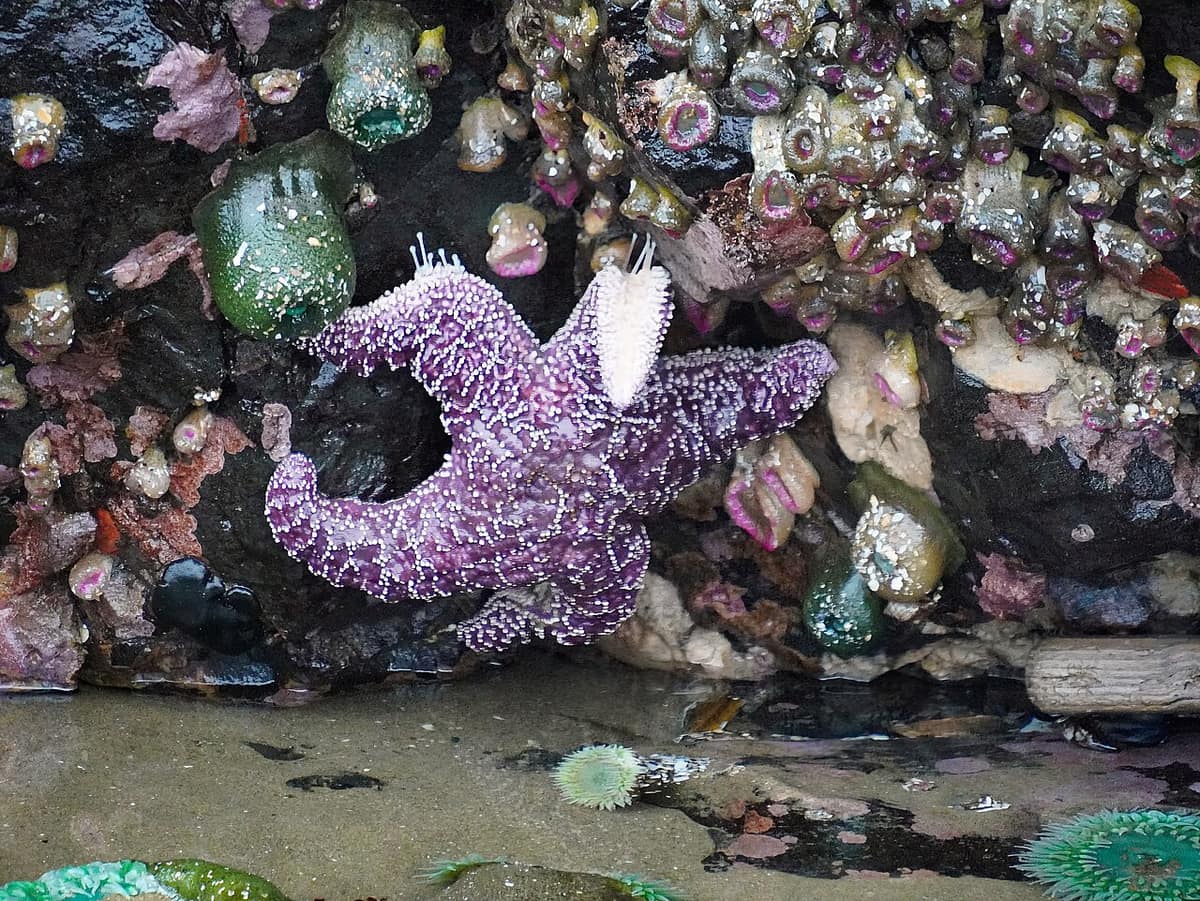
A sea star and anemones in the Haystack Rock tidepools — a designated Marine Garden, with nesting puffins on the rock above — Photo: John Manard / Wikimedia Commons (CC BY-SA 2.0)
What Owning a View of the Rock Means
Properties within visible range of Haystack Rock carry a premium that is among the most rational premiums in coastal Oregon real estate. The reasoning is straightforward: the rock is permanent, protected, and irreplaceable. No development can occur on or near it that would obstruct sightlines. No commercial construction will rise between an ocean-facing property and its view of the rock. The Oregon Islands National Wildlife Refuge designation ensures that the ecology, and the visual integrity of the landscape, will be maintained in perpetuity.
That permanence is worth more than buyers sometimes recognize when they are evaluating view premiums in other coastal contexts. A view of a working harbor can be impaired by development. A view of a popular beach can be altered by erosion or seasonal use patterns. A view of Haystack Rock — particularly a direct, unobstructed view from an oceanfront or elevated oceanview property — cannot be taken away by anything short of geological change on a timescale that exceeds any reasonable investment horizon.
Properties with direct Haystack Rock views from the living areas or primary bedroom are routinely priced at the upper end of the Cannon Beach market, with oceanfront properties at the very top. Even properties without a direct rock view but within the half-mile radius where the rock is visible from the beach or the street benefit from its proximity — they are within walking distance of one of the Pacific Coast's signature landmarks, and that proximity is baked into the address.
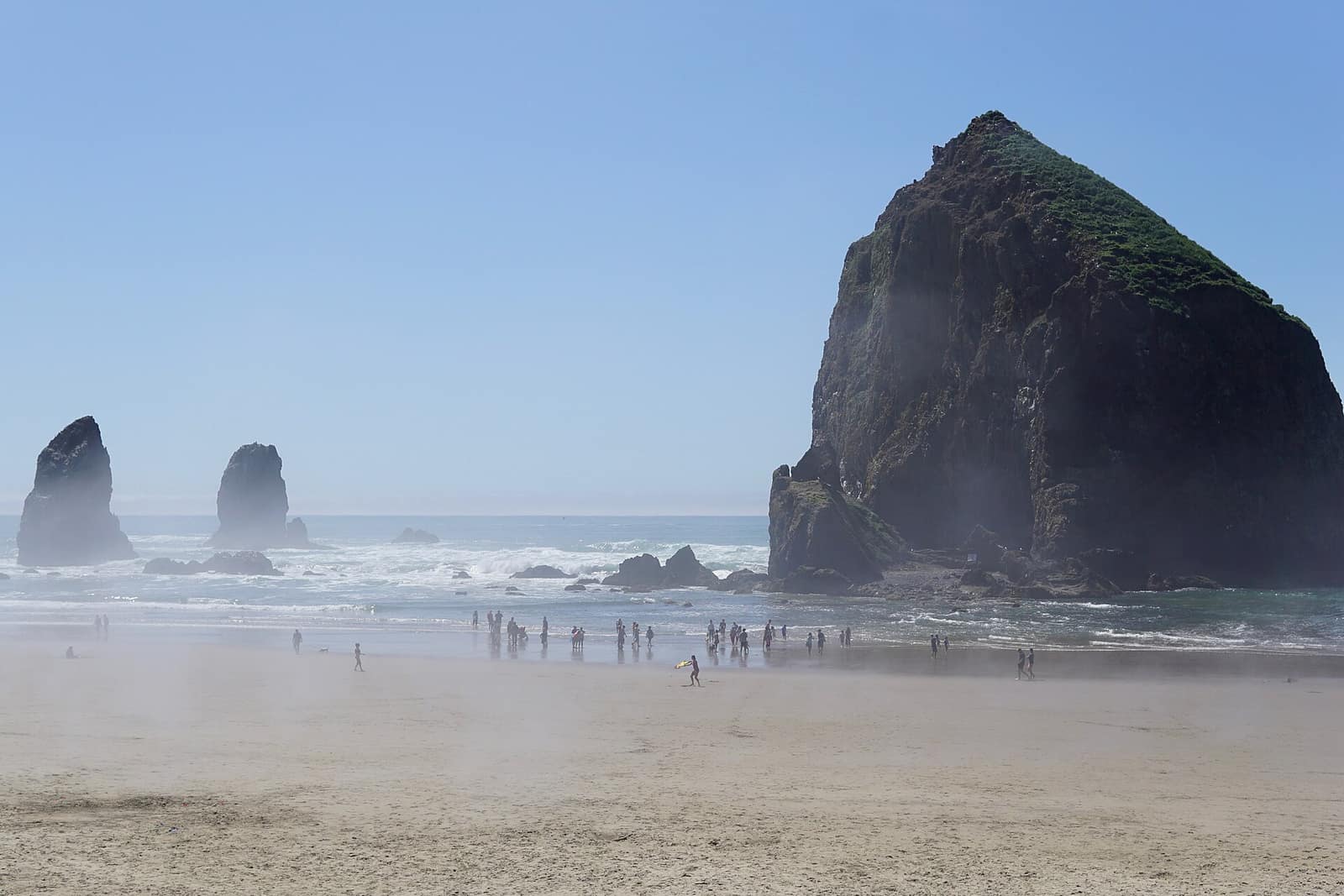
At 235 feet, Haystack Rock anchors the Cannon Beach landscape — and the real estate market around it — Photo: Lianguanlun / Wikimedia Commons (CC BY 4.0)
The Practical Reality of Living Near the Rock
The tourist crowds around Haystack Rock during summer are real. On a sunny July weekend, the beach in front of the rock can feel like a state park on opening day — families with dogs, photographers with tripods, guided tours, tide pool visitors with buckets they aren't supposed to have, and the ambient noise of a large number of people having a good time. For property owners within earshot of the beach, this is part of the summer reality.
What long-term residents will tell you is that you develop a different relationship with the rock over time. You learn the tide tables. You learn that 6 a.m. on a Tuesday in early June, the beach is empty and the rock has the light on it in a way that no photograph has ever quite captured. You learn the specific pleasure of being at the rock in November with the storms building offshore, when the tourists are gone and the naturalists are home and you can stand at the edge of the tidal zone and listen to the surf work on the basalt without anyone else within a hundred yards. That is the resident experience of Haystack Rock, and it bears almost no resemblance to the tourist experience.
The Takeaway on Haystack Rock Views: A Haystack Rock view is the one thing in Cannon Beach real estate that qualifies as a permanent feature without any qualification. The view cannot be blocked, the wildlife won't be removed, and the ecological significance of the site ensures ongoing public and institutional attention that protects rather than diminishes what you're looking at. If you're evaluating two otherwise comparable Cannon Beach properties and one has a Haystack Rock view, the premium for that view is rational in a way that not all real estate premiums are.
Thinking about buying in Cannon Beach? Coastal homes come with their own financing questions — second home or rental, flood insurance, condo eligibility. Phuong Ha, a licensed Oregon loan officer (NMLS #1839449), can help you sort them out before you make an offer.
Related reading