The phrase "art town" gets applied loosely to a lot of places on the Pacific Coast. A few galleries, some galleries that are really gift shops, an annual event, and the description starts appearing in tourism materials. Cannon Beach is not that kind of art town. It is, by measurable standards, one of the most concentrated and genuinely serious small arts communities in the Pacific Northwest — and the distinction matters, both as a quality of life claim and as a real estate factor.
More than 20 galleries operate on a corridor centered on Hemlock Street, the town's main commercial spine. The artists and gallery owners who comprise this community are not seasonal operators. Many of them have been in Cannon Beach for decades. The work shown here — painting, sculpture, jewelry, ceramics, photography — regularly reaches standards that would be at home in Portland's Pearl District or Seattle's Capitol Hill arts districts. The difference is that in Cannon Beach, you can walk to the beach from the gallery in three minutes.
The Scale and Depth of the Scene
Twenty-plus galleries in a town of 1,700 people represents one of the highest gallery-to-resident ratios in Oregon. The raw number isn't what matters, though — what matters is the quality and range. Cannon Beach's galleries cover a wide spectrum of media and price points. There are galleries focused on Pacific Northwest landscape painting, which is a serious and historically significant tradition. There are sculpture galleries showing work that requires forklift-level logistics to install. There are jewelry studios where the designer is also the maker and will discuss the metallurgy of what you're looking at if you're curious. There are photography galleries showing fine-art prints of the Oregon Coast at a quality that rewards close inspection.
The range means that the arts scene is genuinely accessible rather than intimidating. You don't have to be a collector to walk Hemlock Street and get something out of the experience. You also don't have to limit yourself to tourist-tier work — if you are a serious collector, the galleries in Cannon Beach have serious work to show you.
A Year-Round Artist Community
What separates Cannon Beach from seasonal arts destinations is the fact that the artist community is here year-round. The gallery owners who've been operating on Hemlock Street for 20 or 30 years are not winter residents of Scottsdale who come back in June. They live here. The painters whose work hangs in the galleries are, in many cases, working in studios in and around Cannon Beach through the winter months, when the light is different and the town is quieter and the coast provides a different kind of material to work with.
That year-round presence creates a community culture that is distinct from beach towns where the cultural life is entirely seasonal. In Cannon Beach, there are events, openings, and community gatherings throughout the year. The Stormy Weather Arts Festival in November is the most visible expression of this, but it represents a pattern of engagement that runs through the entire calendar. For buyers who are evaluating not just a property but a community to join, the arts scene's year-round vitality is a meaningful differentiator.
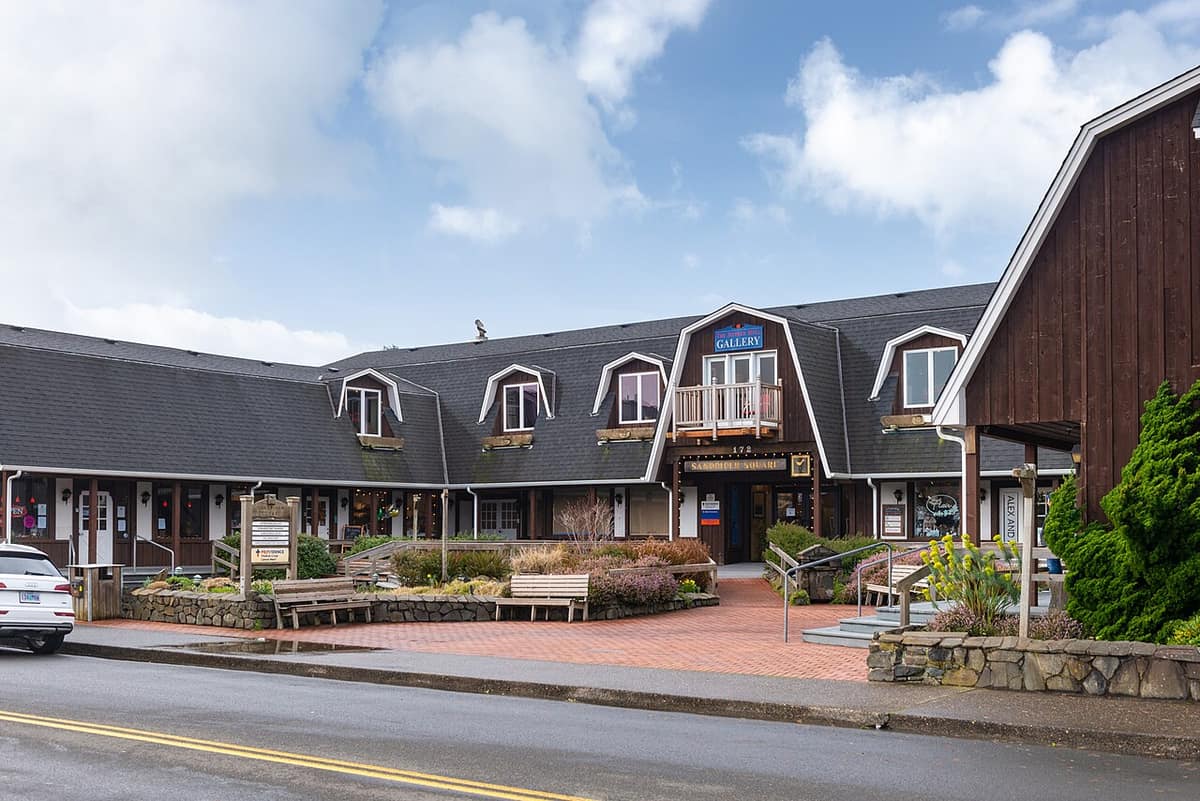
A gallery at Sandpiper Square in downtown Cannon Beach — Hemlock Street's gallery corridor makes the town a walkable arts destination unlike anything else on the Oregon Coast — Photo: Gary Halvorson, Oregon State Archives / Wikimedia Commons (CC BY 4.0)
The Hemlock Street Experience as Daily Reality
One of the things that buyers who visit Cannon Beach for the first time find hard to fully absorb is that the gallery experience is not a destination activity for residents — it is the texture of daily life. Walking to the bakery in the morning, you pass three galleries. Running an errand on a Tuesday afternoon, you glance in a window and see a new show has gone up. Taking visitors from Portland for the weekend, the gallery walk is the natural anchor of the Saturday afternoon program, not a scheduled excursion.
That ambient access to art changes how you engage with it. You become more familiar with the galleries and their respective focuses, which means you notice when something new and significant arrives. You develop opinions about which spaces show consistently interesting work and which are more commercial. You know the gallerists by name, and they know what you respond to. The relationship between resident and gallery in Cannon Beach is genuinely different from the tourist relationship — deeper, more reciprocal, and more sustaining over time.
For buyers who are not artists or collectors, this matters in a different way: the gallery presence on Hemlock Street is what makes the street itself an interesting place to walk. It provides visual and intellectual variety, creates pedestrian traffic that supports the restaurants and coffee shops, and maintains the aesthetic quality of the commercial environment in ways that purely retail-focused downtowns rarely achieve.
The Stormy Weather Arts Festival Connection
The Stormy Weather Arts Festival, held the first weekend of November, is the gallery community's annual statement about what it values. Rather than a summer event that chases the tourist peak, the arts community chose to celebrate the season that most coastal towns write off — and chose to center the celebration on art rather than on a food or music hook. That choice reflects the genuine priorities of the community: this is a place where the galleries are the anchor, not the amenity.
The festival's success over many years — galleries participating fully, ticket events selling out, visitors coming specifically for the art rather than incidentally — demonstrates that the arts identity has real market support, not just self-promotion. People plan trips to Cannon Beach in November for the galleries. That is an unusual thing to be able to say about any coastal community.
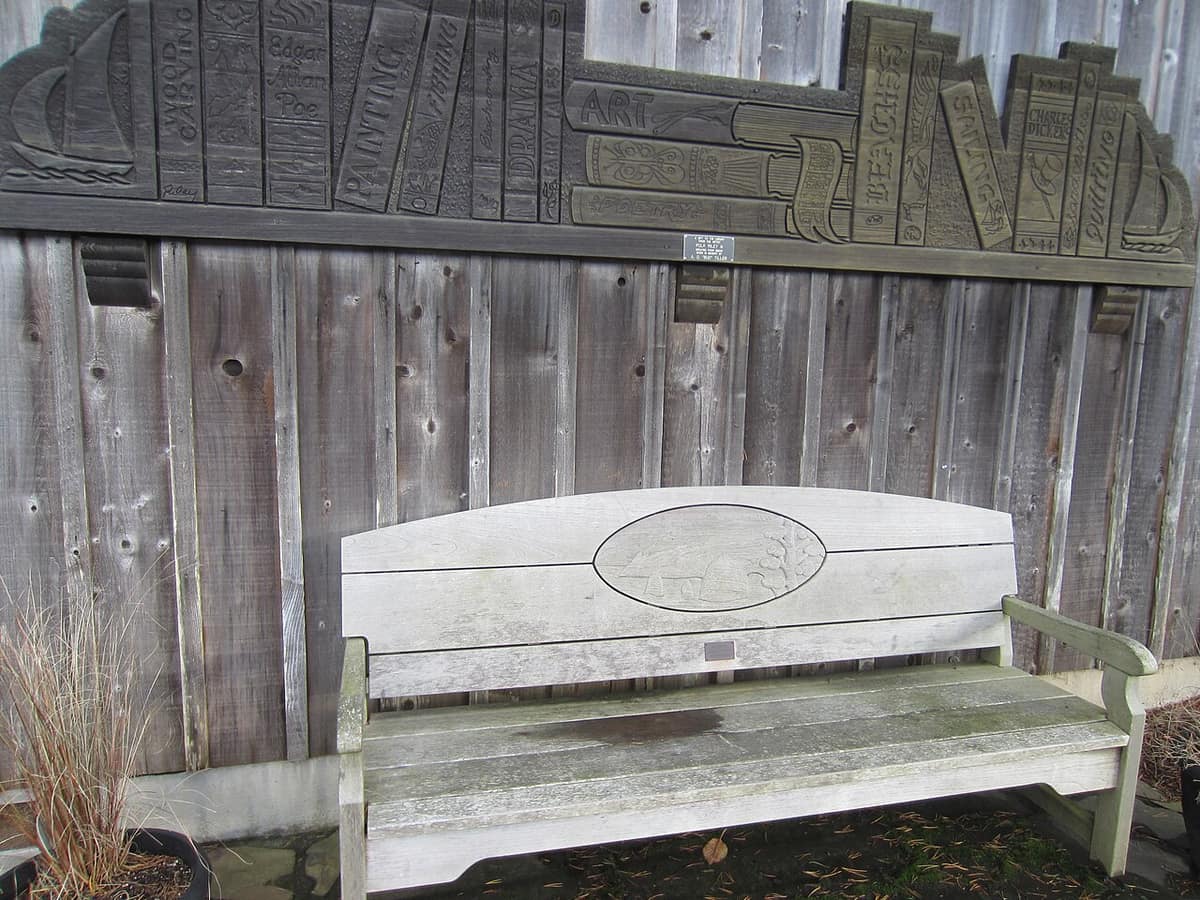
Carved woodwork above a bench in downtown Cannon Beach — the town's art extends well beyond its gallery walls — Photo: Another Believer / Wikimedia Commons (CC BY-SA 4.0)
How the Arts Identity Protects Property Values
There is a body of research and real-world observation supporting the connection between strong arts communities and real estate value stability. The mechanism is not mysterious: arts towns attract residents and visitors with above-average incomes and strong preferences about quality of place. Those residents maintain their properties to higher standards, support the local businesses that create the walkable, attractive town character, and participate in civic governance in ways that protect the quality of the community over time. The cycle is self-reinforcing in the positive direction.
Cannon Beach's arts identity also serves as a de facto quality filter for development and commercial activity. The community has consistently resisted the kind of generic commercial development that tends to homogenize coastal towns — chain restaurants, franchise retail, the lowest-common-denominator tourist trade. The galleries and the community that supports them create a gravitational pull toward independent, quality-focused businesses, which preserves the character that attracts high-quality buyers in the first place.
Whether you attribute this to the arts community directly or to the demographic it attracts, the result is observable: Cannon Beach has maintained its desirability and value premium across multiple real estate cycles in ways that comparable-sized coastal communities without a strong cultural identity often have not. That stability is not guaranteed to continue indefinitely, but the depth of the arts community — its age, its year-round character, and its genuine quality — suggests a more durable foundation than a cultural scene that emerged recently or is driven primarily by marketing.
Who Finds Cannon Beach the Right Fit
Owning in an art town is different from owning in a pure beach town. The practical differences are real: the gallery walks, the events calendar, the restaurant scene, the quality of the Hemlock Street pedestrian experience. But the more fundamental difference is one of community identity and the culture you'd be joining. Cannon Beach attracts buyers who care about the place they're living in beyond the view from the deck. They are, in general, people who are curious about the world, interested in the arts and culture at some level, and drawn to communities that have invested in their own character.
That profile is not for everyone, and Cannon Beach's price point reinforces the selectivity. But for buyers who recognize themselves in that description — who want a coastal property that is part of a living community rather than a managed resort experience — Cannon Beach represents something that is genuinely difficult to find anywhere on the Pacific Coast.
The Takeaway on the Arts Scene: Compare Cannon Beach with any other town on the Oregon Coast and the difference in community character is immediately apparent. The arts scene isn't a selling point to justify the price — it's a real feature of what you're buying into. Visit only in summer and you may miss it behind the crowds. Spend time on Hemlock Street on a quiet Thursday instead: walk into three galleries, talk to a gallerist for twenty minutes, and walk out thinking about what you saw. That's when you understand what Cannon Beach is.
Thinking about buying in Cannon Beach? Coastal homes come with their own financing questions — second home or rental, flood insurance, condo eligibility. Phuong Ha, a licensed Oregon loan officer (NMLS #1839449), can help you sort them out before you make an offer.
Related reading