There is something that happens to people when they visit Bandon's Old Town for the first time. They walk the compact blocks along the Coquille River, they notice the working boats in the harbor, they look south toward the sea stacks rising from the surf at Face Rock, and they begin to understand that this is not a town that was built to look like a coastal destination. It is a coastal destination that simply became one by being itself. That distinction is increasingly rare on the Oregon Coast, and it is the core reason that Old Town Bandon keeps drawing buyers year after year, even as other coastal markets go in and out of fashion.
This piece is about what Old Town Bandon actually is, what it is like to live within walking distance of it, and what it offers buyers who want something more substantive than a vacation-town address.
What Old Town Is
Old Town Bandon is a compact commercial and residential district at the mouth of the Coquille River, where the river meets the Pacific Ocean. The neighborhood extends south toward Face Rock State Scenic Viewpoint, a half-mile walk from the heart of Old Town, and east along the river harbor where fishing boats and recreational vessels share the water with birds that have been coming to this estuary for far longer than any of the buildings nearby.
The architecture is what you would expect from a town founded in 1891 and largely rebuilt after a catastrophic fire in 1936 destroyed much of the original structures: functional, modest, occasionally beautiful, never pretentious. Old Town has not been renovated into a facsimile of its past. It has been maintained and added to by people who live here and use these buildings for real purposes — restaurants, galleries, shops, working businesses that serve the community as much as they serve visitors.
The scale matters. Old Town is compact enough to walk end-to-end in fifteen minutes, which means that living nearby gives you genuine pedestrian access to a real commercial district — not just a couple of shops and a coffee kiosk, but a full neighborhood with dining options, art, provisions, and the waterfront.
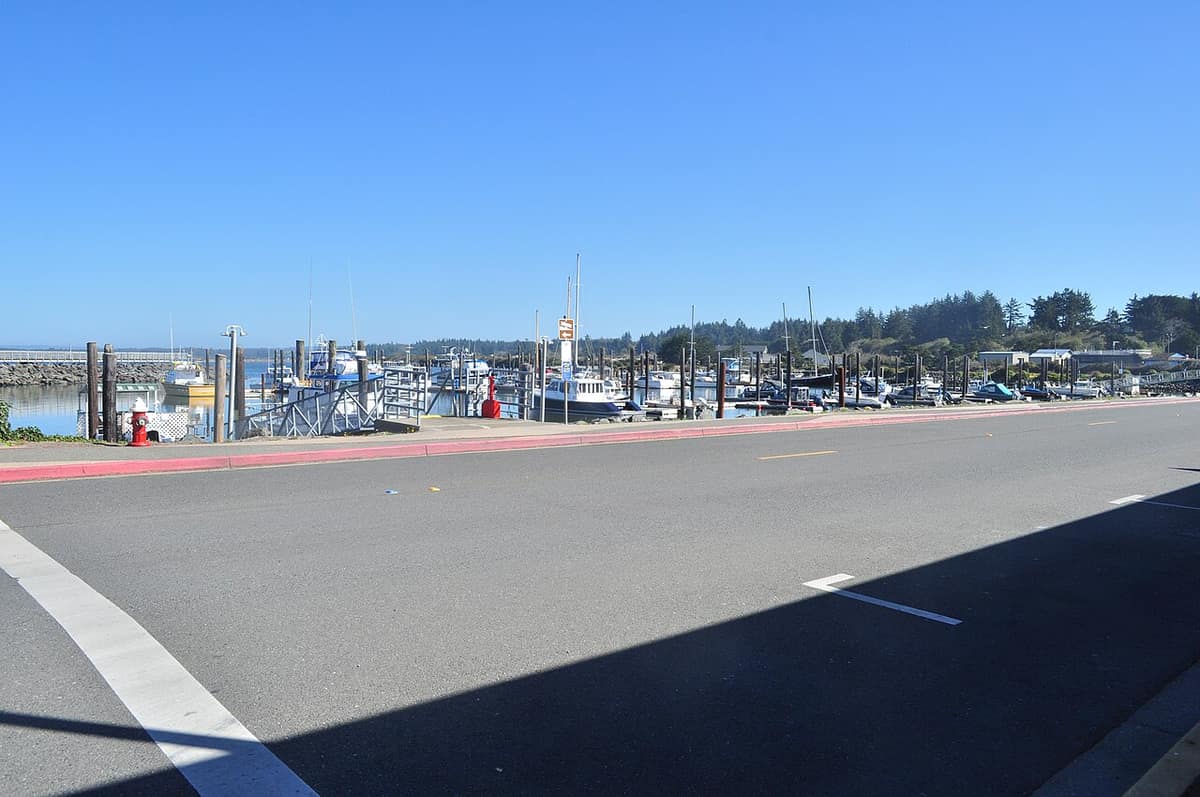
Bandon's harbor sits where the Coquille River meets the Pacific — a working waterfront that hasn't been sanitized — Photo: Joe Mabel / Wikimedia Commons (CC BY-SA 4.0)
The Coquille River Scene
The Coquille River is not scenery. It is a working waterway with commercial fishing operations, recreational boats, and an estuary ecosystem that supports significant bird populations. Brown pelicans, great blue herons, and harbor seals are regular presences at the river mouth — the jetty area where the river opens to the Pacific is a reliable spot for wildlife observation in any season.
The jetty walk is one of those daily rituals that Old Town residents describe as central to their quality of life. It is accessible on foot from Old Town, takes about thirty minutes round-trip, and provides views of both the river estuary and the open Pacific. In summer, it is warm and breezy. In winter, it is dramatic — the storm swells that roll in from the North Pacific between November and February crash the jetty with real force, and watching this from the protected walkway is one of those experiences that distinguishes coastal living from coastal visiting.
The river also provides context for the town's commercial fishing identity. Bandon is not purely a tourism economy — it is a fishing town, a cranberry town, and a golf-destination town layered on top of each other. The harbor reinforces the fishing and working-waterfront identity in a way that keeps the place honest. When you live in Old Town and walk past boats being prepped for the day's work, you are reminded that Bandon has always been about more than attracting outsiders.
Face Rock and the Sea Stacks
Face Rock State Scenic Viewpoint is a half-mile walk from Old Town, and the sea stacks visible from it are among the most photographed natural features on the Oregon Coast. The formations — Face Rock, Cats and Kittens Rock, the Table Rocks, and others rising from the surf — create a visual drama that changes depending on the tide, the light, and the season. At low tide, the surrounding tidepools become accessible. At high tide in a winter storm, the waves breaking over the nearer stacks send spray high enough to be visible from the road above.
Living within walking distance of this landscape is different from driving to see it. When it is five minutes from your door, you go more often, in different conditions, and at different times of day. You come to know it the way you know a familiar route rather than the way you know a destination. This shift from tourist relationship to resident relationship with a natural landmark is one of the understated pleasures of buying close to Old Town in Bandon.
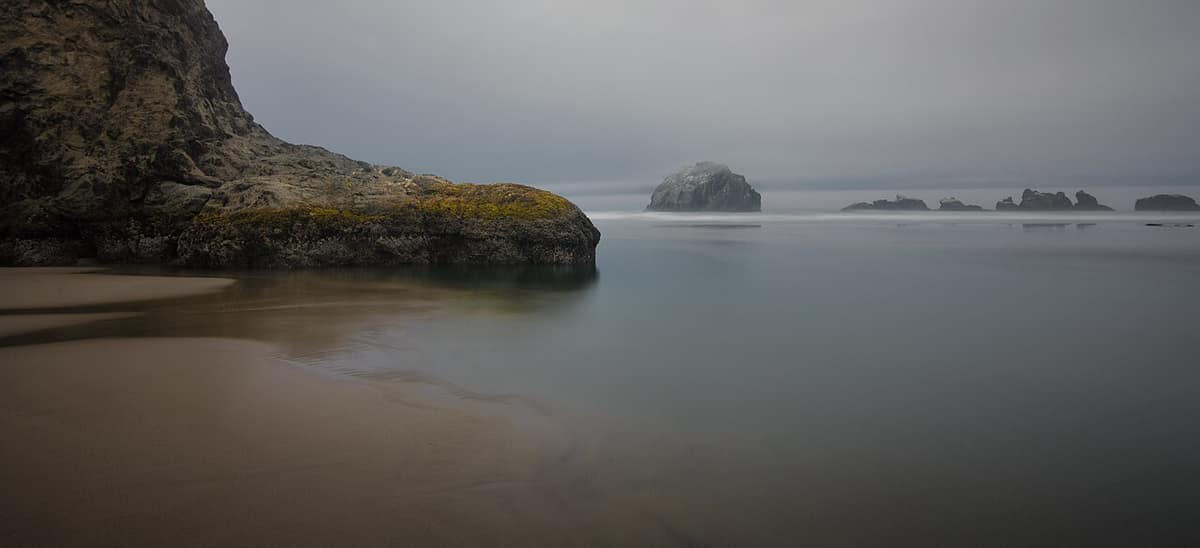
Face Rock and its neighboring sea stacks are among the most photographed natural landmarks on the southern Oregon Coast — Photo: Adam Meek / Wikimedia Commons (CC BY 2.0)
The Old Town Walking Experience
On any given day, Old Town Bandon offers the kind of walkable commercial experience that coastal towns often advertise and rarely deliver. Bandon delivers it. You can have breakfast at Bandon Baking Co. and Deli, stop at Misty Meadows Jam and Gift Shop to pick up local cranberry preserves, have lunch at Old Town Tap and Grill or Bandon Rain, browse one of the galleries that participate in the monthly First Friday art walk, and end at Lord Bennett's for dinner with a sea stack view — all on foot, all in the same compact neighborhood.
The First Friday art walk is worth noting as a specific example of the kind of community event that gives Old Town its texture. Monthly gallery openings draw local artists and community members together in a regular, low-key celebration of the creative culture that small coastal towns tend to either have or not have — and Bandon has it. The gallery scene is genuine, the artists are present, and the events are community-oriented rather than purely commercial.
Storm Watching from Old Town
One of the most distinctive aspects of Old Town Bandon as a lifestyle is storm watching season. From November through February, the North Pacific delivers swells to the southern Oregon Coast with a regularity and power that makes this stretch one of the premier storm watching destinations in the Pacific Northwest. The sea stacks at Face Rock amplify the drama — waves that might be impressive on an open beach become something spectacular when they break against rock formations that rise thirty or forty feet from the water.
For residents rather than visitors, storm watching is not a weekend excursion — it is part of winter life. Living in Old Town during a storm season means stepping outside when the wind picks up and walking to the viewpoint to see what the Pacific is doing today. It means knowing which days the spray is highest, which directions produce the best wave action, and which locations along the viewpoint trail give the most protected vantage point. This is the kind of relationship with a place that cannot be replicated from a vacation rental.
Who Buys Near Old Town
The buyers who focus specifically on Old Town proximity tend to fall into recognizable categories. Walkers who want the Oregon Coast without requiring a car for daily errands — Old Town provides that in a way that much of the southern coast does not. Gallery enthusiasts and people in creative fields who value the monthly art walks and the presence of an arts community in their daily environment. People who have done the research and concluded that Bandon offers the authentic coastal character they want without the traffic, congestion, and tourism-resort aesthetic of Cannon Beach or Newport at peak season. And buyers who have visited Bandon Dunes, fallen in love with the area, and are now looking for something with more community character than a resort property.
What unites them is a preference for substance over surface. Old Town Bandon is not polished. It is not Seaside's Promenade or Cannon Beach's gallery row — it is a smaller, rougher, more honest version of coastal commercial life, and for buyers who prefer that to the curated tourism experience, there is nothing quite like it on the Oregon Coast.
The Takeaway on Old Town: Compared with the rest of the Oregon Coast, Bandon's Old Town is singular. Nowhere else on the coast do you get this combination: a genuinely walkable historic district, a working harbor, world-famous sea stacks within a half-mile walk, a monthly arts community, and a town with three distinct economic identities giving it real depth. The buyers who find their way to Old Town Bandon tend to be people who have done the rounds of the coast and concluded that they want something more real than the rest. If that describes you, know that properties near Old Town are limited in supply, because there is nowhere else like this.
Thinking about buying in Bandon? Coastal homes come with their own financing questions — second home or rental, flood insurance, condo eligibility. Phuong Ha, a licensed Oregon loan officer (NMLS #1839449), can help you sort them out before you make an offer.
Related reading