There is a moment, somewhere around mile fifteen upriver from Gold Beach, when the canyon walls close in and the world goes quiet except for the roar of water and the deep thrum of the jet boat engine. The forested ridgelines rise hundreds of feet on both sides. There are no roads here. No houses. No cell signal. Just the Wild and Scenic Rogue River doing what it has always done — cutting through one of the most intact wilderness corridors on the entire Pacific Coast. For anyone thinking about buying in Gold Beach, that moment is worth understanding. It is not a tourist attraction you visit once. It is your backyard.
What Makes the Rogue River Special
The Rogue River earned its federally protected Wild & Scenic designation in 1968 — one of the original eight rivers protected under the Wild and Scenic Rivers Act when Congress established the program. The designation applies to the upper river corridor, which runs through deep wilderness canyons that are genuinely inaccessible by road. There are no highways into the heart of the Rogue's most dramatic terrain. Access is by trail, raft, or jet boat. That is not a limitation; it is the point.
The river originates near Crater Lake in the Cascade Mountains and runs 215 miles to the Pacific Ocean at Gold Beach. The lower section, from the town of Grants Pass to the coast, is the Wild & Scenic stretch — a corridor of old-growth Douglas fir, Port Orford cedar, tanoak, and madrone that represents some of the last intact temperate rainforest on the West Coast. The canyon walls drop steeply to the river's edge in places, creating dramatic gorges that have been compared favorably to smaller versions of the Grand Canyon by visitors who have seen both.
The river supports world-class populations of Chinook salmon and steelhead trout. Both species depend on cold, clean water and intact riparian habitat — which the Wild & Scenic designation has effectively preserved for more than fifty years. The Rogue is consistently ranked among the top ten fishing rivers in Oregon, which is saying something in a state that takes its fishing seriously. Spring Chinook arrive in late April and May. Fall Chinook come through September and October. Winter steelhead run November through March. For a fishing-minded buyer, this is not a selling point — it is an entire lifestyle.
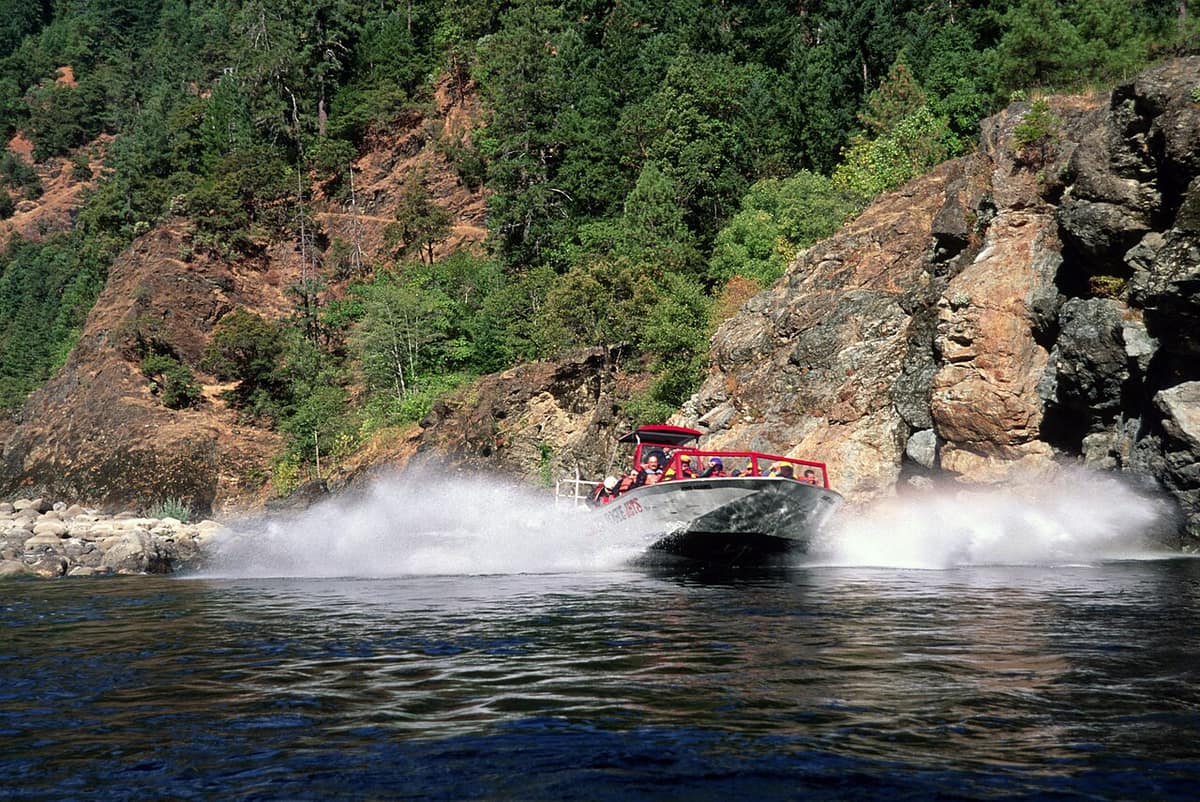
A jet boat powers past the rock walls of the Rogue River canyon — Photo: U.S. Forest Service- Pacific Northwest Region / Wikimedia Commons (Public domain)
The Jet Boats: How the Technology Works
The jet boats that carry passengers up the Rogue are not conventional motorboats with propellers. They are flat-bottomed craft powered by water-jet propulsion — a technology that was refined specifically for rivers like the Rogue, which are too shallow and rocky for propeller-driven boats to navigate safely at speed. The system works by drawing water into the hull through an intake, accelerating it through an impeller, and expelling it through a nozzle at the stern. The thrust moves the boat forward; the direction of the nozzle steers it.
The practical result is extraordinary: a jet boat can operate in as little as six inches of water. The flat-bottom hull design allows it to slide over submerged rocks and navigate rapid sections that would destroy a propeller-driven craft. At full speed — which is considerable — these boats skim across the surface of the river with a lightness that seems improbable given their size. The pilots who run the Rogue have typically spent years learning the river, memorizing rock positions that change seasonally with water levels, and developing the instincts to read moving water at speed. Watching a skilled Rogue jet boat pilot thread a technical rapid is a genuinely impressive thing.
The Tours: Jerry's and the Mail Boats
Two operators run the major jet boat tours from Gold Beach: Jerry's Rogue Jets and Rogue River Mail Boat trips. Both have been operating for decades and both have earned strong reputations. The differences between them are partly historical and partly practical.
Jerry's Rogue Jets offers both the 64-mile round trip to Agness and the longer 104-mile round trip that penetrates deeper into the wilderness. The 64-mile tour is the standard option for most visitors — it reaches Agness with a lunch stop, covers some of the most dramatic canyon sections, and returns in time for an afternoon at Gold Beach. The 104-mile tour is for those who want to go deeper, and it delivers: the upper sections of the route see far fewer visitors and the canyon scenery becomes progressively more dramatic.
The Mail Boat trips carry historical significance that Jerry's doesn't claim. Since the 1890s, the U.S. Mail has been delivered by boat to the remote community of Agness — a settlement so deep in the Rogue wilderness that until well into the twentieth century, the river was the only practical supply route. The mail service is still active. When you ride the Mail Boat, you are riding a working federal mail route on a Wild & Scenic river, which is a fairly remarkable thing to be able to say. Both operations run daily through the spring and summer season and into fall. Call ahead in shoulder season to confirm schedules.
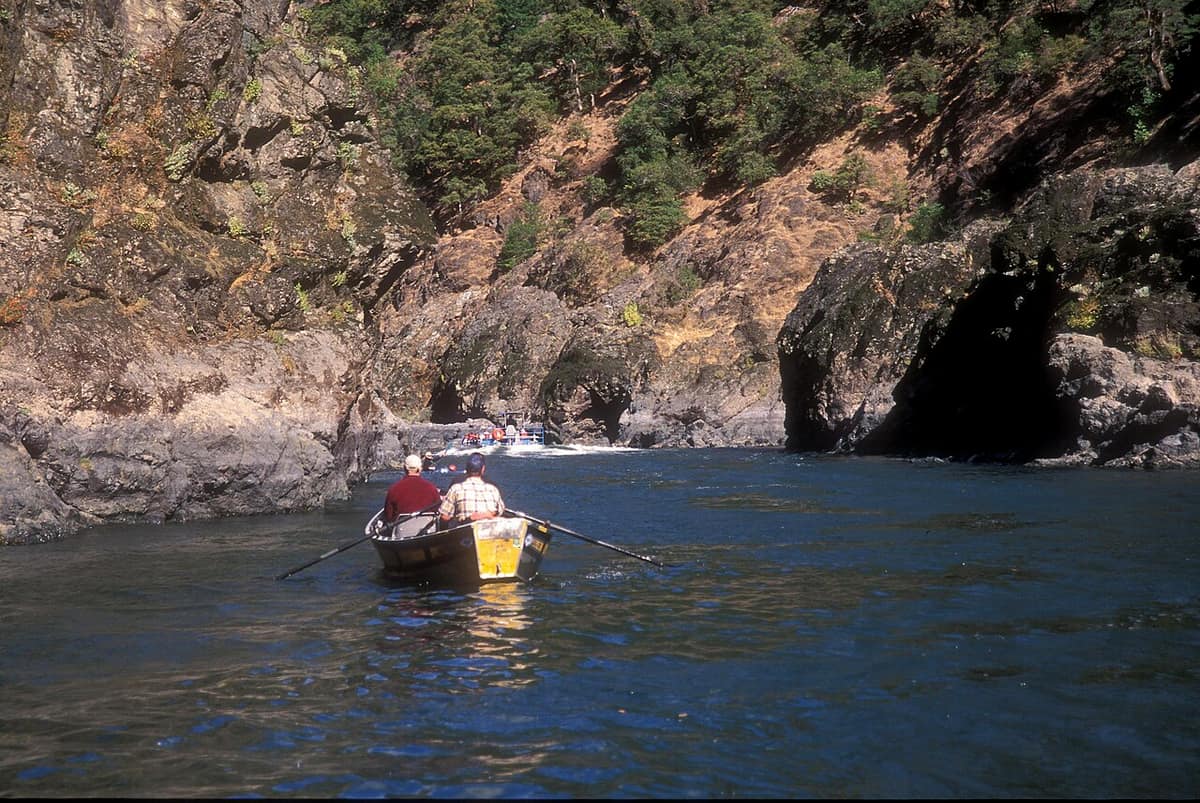
A drift boat and a jet boat share a quiet stretch of the Rogue's rocky, forested canyon — Photo: U.S. Forest Service- Pacific Northwest Region / Wikimedia Commons (Public domain)
What You See on the River
The wildlife viewing on the Rogue is not incidental — it is one of the tour's primary features. Bald eagles nest along the river corridor, and sightings are common enough that tour operators have stopped making a production of each one. Black bears come to the river to fish and to drink, and sightings on the lower wilderness sections are frequent enough that guides keep watch for them. Roosevelt elk — the large, dark subspecies native to the Pacific Coast — live in the river corridor and are occasionally visible on the banks, particularly in the morning and evening hours. Osprey fish the river from overhanging snags. River otters work the shallow sections. Great blue herons stand motionless in the shallows. The riparian corridor is a genuine wildlife refuge, and the boat puts you directly in the middle of it at eye level.
The canyon scenery is the other constant. In the first miles above Gold Beach, the river moves through a broad valley with open views. As you travel upriver, the canyon walls steepen. By the time you reach the more dramatic sections, the cliffs are rising hundreds of feet on both sides, draped with old-growth forest that has never been logged because there was never a way to get it out. The light changes through the day as the sun moves across the canyon rim. Morning runs have a different quality than afternoon runs. Gold Beach residents who have taken the tours multiple times generally report that familiarity only deepens the experience.
What This Means for Gold Beach Residents
Most visitors to Gold Beach take the jet boat tour once. For residents, the calculation is entirely different. The tours operate spring through fall, and for buyers who locate in Gold Beach specifically because of the Rogue River, the jet boat is not a tourist experience — it is a recurring option. You can take a morning run on a Tuesday in June because it is there and you live here. You can bring family and friends who visit and show them the river that defines your address. You can go once a season and find that the river shows you something different each time — different water levels, different wildlife positions, different light.
The fishing dimension compounds this. Many Gold Beach buyers come specifically for access to the Rogue's salmon and steelhead runs. Guided drift boat trips operate from Gold Beach on the lower river. The jet boat corridor overlaps significantly with the fishing zones, meaning that river you are touring is also the river you are planning to fish on Thursday with a drift boat guide. The Rogue is not a backdrop for Gold Beach — it is the reason Gold Beach is where it is.
The Takeaway: In Gold Beach, the Rogue River belongs in every home-buying conversation. Buyers who come for the river understand Gold Beach in a way that buyers focused purely on ocean views sometimes don't. The Wild and Scenic designation is a permanent protection — no development, no dams, no degradation of the corridor. If you are buying near a Wild and Scenic river, you are buying something that will still be there in the same condition fifty years from now. That is a rare thing to be able to say about a lifestyle amenity.
Planning Your First Tour
Both Jerry's Rogue Jets and Rogue River Mail Boat trips can be reached directly — both operations have maintained booking infrastructure for decades and both welcome reservations. Dress in layers; the canyon can be significantly cooler than Gold Beach itself due to elevation gain and shade. The 64-mile round trip takes approximately five to six hours with the Agness lunch stop. The 104-mile round trip is a full day. Wear non-slip footwear. Bring a camera with a zoom lens if wildlife is a priority — you will have use for it.
For buyers doing research visits to Gold Beach, scheduling a jet boat tour during your visit is not optional. The Rogue River is the single most defining feature of Gold Beach's appeal, and seeing it from the water puts the town's location in complete context. The river mouth is visible from much of the town. The canyon begins less than five miles upriver. Once you have seen what lies beyond that first bend, Gold Beach real estate looks different — because you understand what you would be living next to.
Related reading